


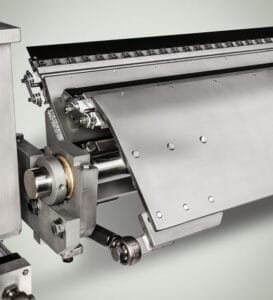
Efficient doctoring is an important element in paper machine productivity. Doctors are required in many positions to remove contaminants, lead the sheet during threading and breaks, remove water from rolls, as well as specialty functions such as creping and coating. The broad application requirements call for an engineered approach at every touchpoint, and it starts with the right foundation—the doctor back and blade holder.
The doctor back is the major support beam for the blade. Structurally, it must meet or exceed application needs for size, balance, strength, deflection, and vibration resistance. Going off-the-shelf here just won’t cut it.
You have to select from structural angles, pipes, specially fabricated weldments, scoop backs, or apron backs specific to the space and production requirements. Carbon steel, 304, 316, or special stainless steels in solid or clad construction should be selected.
Machining of the blade holder-mounting surface is critical. This important surface must conform to the roll, whether it is straight or crowned. As a quality control measure, it helps to chart the machining results in thousandths of an inch. For reference purposes, it is good practice to retain the chart as a permanent record of your doctor.
Once the integrity of the critical mounting surface is set, the appropriate blade holder can be securely attached. From there, it’s a matter of choosing a standard or custom holder to meet your needs.
Process application
Doctor blades have to perform a variety of functions. Depending on machine position, the blade may be required to remove water, clean the roll, remove the sheet, direct the sheet, or some combination of these functions. Proper blade design must consider all of these factors, as well as many others.
Proper design and manufacturing procedures are crucial to successful installation, start-up, and ongoing performance.
Doctor size
Doctors must be properly sized for the application. Considerations include roll width, machine speed, harmonics analysis, and space constraints on the paper machine. The doctor back sections increase in size as the width and machine speed increase. However, there are often alternative designs that can meet strength requirements in tight applications.
Roll crown
Doctors should be designed to match the roll crown where applicable. Changes in roll crown may require modifications to the doctor. Proper crown information is critical to the performance of the doctor.
Loading pressure
Proper loading pressure is a critical element of doctor performance. Design and engineering characteristics of doctor holders are key to achieving proper loading pressure, particularly when equipped with pressure rig loading.
Pneumatic holders generate loading independent of the doctor balance. However, for safety considerations, Essco doctors are designed with a slight positive natural loading whenever possible. This reduces the risk of the doctor rotating backwards during maintenance procedures.
Oscillation
Most doctor blades clean rolls more effectively when oscillated. The process also helps reduce the risk of scratching or grooving a roll. Although stroke length and frequency are not particularly crucial, it is simply necessary to minimize dwell time at the end of each stroke in order to keep the oscillation continuous.
Corrosion protection
Machine position normally dictates doctor back construction material. Painted carbon steel doctors, stainless steel-clad doctors, and solid stainless-steel doctors all offer varying degrees of protection.
Choosing clad or solid stainless construction is usually driven by cost considerations, where solid doctors are normally less expensive up to a certain point, which can change as stainless-steel prices fluctuate.
Clad doctors require special consideration. For example, Essco’s cladding system includes solid stainless-steel journal pads, a blade holder nosepiece, and cross-machine accessory pads when necessary. This insures that the structural integrity of the cladding remains intact.
As you can see, paper machine doctor blades have to meet a broad range of application requirements that call for specific engineering and design elements. Paper machine productivity depends on it. We can help.
Dale Posvic, Sales/Service Engineer
dposvic@esscoincorporated.com